Aghanya Info Solution Pvt. Ltd.

Software Development

.NET Course

Learn to build web applications and APIs on Microsoft's .NET platform with C# — a modern, strongly typed language known for clear code and excellent tooling.

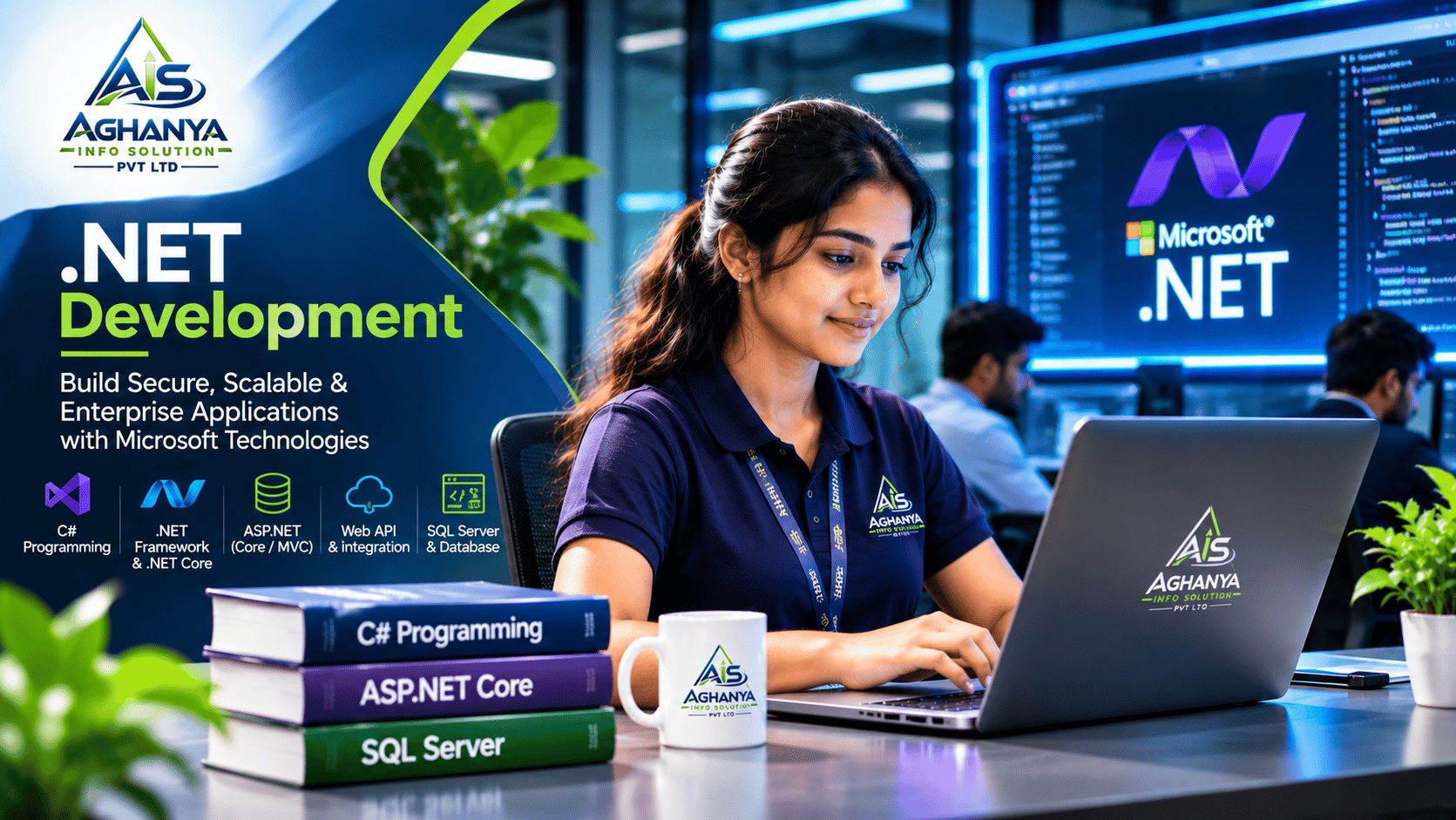
.NET course illustration: a learner working on .NET

The technology

What is .NET?

.NET is Microsoft's open-source developer platform for web, desktop, cloud and mobile applications. C# is its primary language and ASP.NET Core its framework for web applications and APIs, running on Windows, Linux and macOS.

Why it matters

Many businesses run their internal systems, customer portals and services on the Microsoft stack. Developers who understand C#, data access and ASP.NET Core can contribute to those systems with confidence.

What you'll study

Inside the .NET course

.NET is Microsoft's platform for building applications across web, desktop, cloud and services. This course teaches C# alongside the framework concepts you need to build real applications.

You cover the language, object-oriented design, data access with Entity Framework, and building web applications and APIs with ASP.NET Core.

Learning objectives

The skills you may develop. By the end of the course you should be able to:

  • Write object-oriented applications in C#
  • Query and transform data with LINQ
  • Access databases using ADO.NET and Entity Framework Core
  • Build web applications with ASP.NET Core MVC
  • Create RESTful APIs with ASP.NET Core Web API

Course modules

.NET syllabus outline

7 modules, each building on the last — from fundamentals to applied practice.

  1. Module 1: .NET platform basics

    Understand how .NET runs your code and how a project is organised.

    • CLR and the .NET runtime
    • Project structure
    • Visual Studio essentials
  2. Module 2: C# language

    Learn C#, the main language for building on .NET.

    • Types, variables and control flow
    • Methods and parameters
    • Strings and collections
  3. Module 3: Object-oriented C#

    Structure applications with classes, interfaces, events and delegates.

    • Classes and interfaces
    • Inheritance and polymorphism
    • Properties, events and delegates
  4. Module 4: LINQ and generics

    Query and transform data concisely with generics and LINQ.

    • Generic collections
    • LINQ queries
    • Lambda expressions
  5. Module 5: Data access

    Connect applications to SQL Server, directly and through Entity Framework.

    • SQL Server basics
    • ADO.NET
    • Entity Framework Core
  6. Module 6: ASP.NET Core MVC

    Build server-rendered web applications with ASP.NET Core MVC.

    • Routing and controllers
    • Razor views
    • Model binding and validation
  7. Module 7: Web APIs

    Expose data and features to other apps through REST APIs.

    • REST principles
    • ASP.NET Core Web API
    • Dependency injection

Tools & technologies

  • Visual Studio
  • .NET SDK
  • SQL Server
  • Git

Who should consider it

  • Graduates aiming for Microsoft-stack developer roles
  • Developers transitioning to C# and .NET
  • Professionals maintaining .NET applications

Before you start

Basic computer skills. Familiarity with any programming language is helpful.

Batch timings and fees are shared directly by our team on enquiry.

Let's Find the Right Course for You

Tell us what you want to learn and where you are starting from. Our team will help you choose the right course and share the relevant details.

Prefer a call? Request a callback

By sending, you agree to be contacted about this request.

Keep exploring

  • Software Development

    Java

    Build a dependable foundation in Java and learn to write code that other developers can read, test and extend — the habits that matter on real teams.

    Key learning areas

    • Java fundamentals
    • Object-oriented programming
    • Exceptions and I/O

    Suits: Students and graduates starting a software career

  • Software Development

    Python

    Start with a language prized for its readability, then put it to work on files, data and automation — writing code that stays clear as it grows.

    Key learning areas

    • Python foundations
    • Data structures
    • Functions and modules

    Suits: Beginners learning their first programming language

  • Software Development

    PHP

    See how dynamic websites work behind the page — handling forms, sessions and databases with PHP and MySQL, and doing it securely.

    Key learning areas

    • Web basics
    • PHP language
    • Forms and state

    Suits: Aspiring web developers