Aghanya Info Solution Pvt. Ltd.

Software Development

Python Course

Start with a language prized for its readability, then put it to work on files, data and automation — writing code that stays clear as it grows.

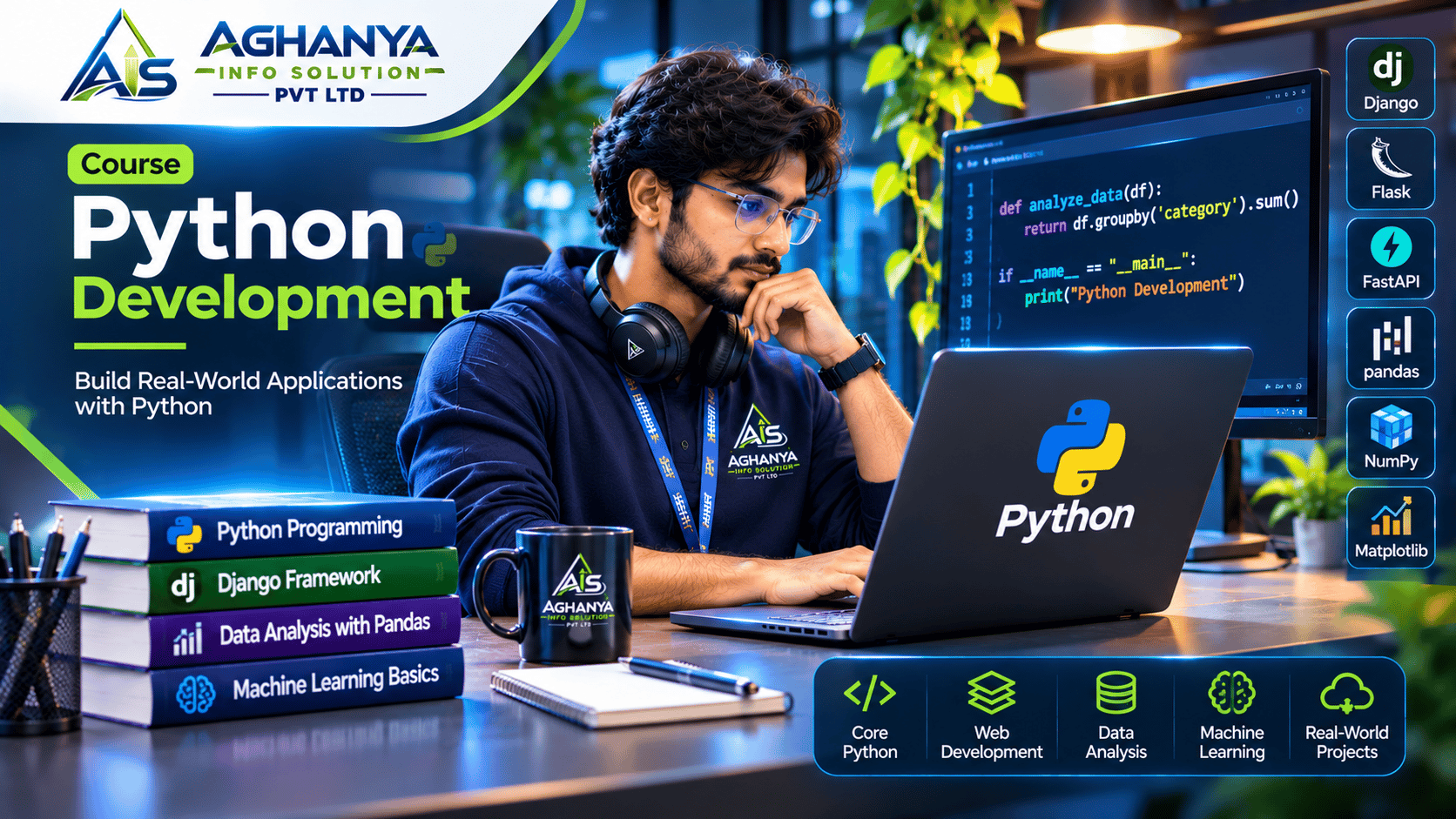
Python course illustration: a learner working on Python

The technology

What is Python?

Python is a high-level, general-purpose language with clean, readable syntax. Its large ecosystem of libraries makes it a practical choice for web development, scripting, test automation and data analysis.

Why it matters

Python's readability makes it a strong first language, and its versatility means one skill serves many roles — developer, tester or analyst. Teams use it to automate repetitive work and to explore and prepare data.

What you'll study

Inside the Python course

Python is valued for its readability and its use across web development, automation, data analysis and testing. This course teaches the language thoroughly and shows how it is applied in practice.

You learn core syntax and data structures, write modular object-oriented code, work with files and databases, and are introduced to widely used libraries for data handling and web development.

Learning objectives

The skills you may develop. By the end of the course you should be able to:

  • Write clear Python using its core data structures
  • Organise code into functions, modules and packages
  • Apply object-oriented programming in Python
  • Read and write files, including CSV and JSON
  • Work with databases from Python
  • Use libraries such as NumPy and pandas for data tasks

Course modules

Python syllabus outline

7 modules, each building on the last — from fundamentals to applied practice.

  1. Module 1: Python foundations

    Install Python and learn its clean, readable syntax.

    • Installation and environments
    • Variables, types and operators
    • Control flow
  2. Module 2: Data structures

    Use Python's built-in structures to hold and organise data.

    • Lists and tuples
    • Dictionaries and sets
    • Comprehensions
  3. Module 3: Functions and modules

    Break programs into reusable functions and modules, and install libraries.

    • Arguments and return values
    • Scope and closures
    • Modules, packages and pip
  4. Module 4: Object-oriented Python

    Organise larger programs with classes and objects.

    • Classes and objects
    • Inheritance
    • Special methods
  5. Module 5: Files and errors

    Read and write files, and handle errors gracefully.

    • Exception handling
    • File I/O
    • CSV and JSON
  6. Module 6: Databases

    Store and query data in a database from Python.

    • SQL basics
    • sqlite3 and MySQL connectors
  7. Module 7: Working with libraries

    Analyse data with NumPy and pandas, and take a first look at web frameworks.

    • NumPy basics
    • pandas data frames
    • Introduction to Flask / Django

Tools & technologies

  • Python 3
  • VS Code / PyCharm
  • Jupyter Notebook
  • pip
  • Git

Who should consider it

  • Beginners learning their first programming language
  • Testers and analysts adding automation skills
  • Developers broadening into scripting and data work

Before you start

Basic computer skills. No prior programming experience required.

Batch timings and fees are shared directly by our team on enquiry.

Let's Find the Right Course for You

Tell us what you want to learn and where you are starting from. Our team will help you choose the right course and share the relevant details.

Prefer a call? Request a callback

By sending, you agree to be contacted about this request.

Keep exploring

  • Software Development

    Java

    Build a dependable foundation in Java and learn to write code that other developers can read, test and extend — the habits that matter on real teams.

    Key learning areas

    • Java fundamentals
    • Object-oriented programming
    • Exceptions and I/O

    Suits: Students and graduates starting a software career

  • Software Development

    .NET

    Learn to build web applications and APIs on Microsoft's .NET platform with C# — a modern, strongly typed language known for clear code and excellent tooling.

    Key learning areas

    • .NET platform basics
    • C# language
    • Object-oriented C#

    Suits: Graduates aiming for Microsoft-stack developer roles

  • Software Development

    PHP

    See how dynamic websites work behind the page — handling forms, sessions and databases with PHP and MySQL, and doing it securely.

    Key learning areas

    • Web basics
    • PHP language
    • Forms and state

    Suits: Aspiring web developers